
In today’s data-driven world, businesses generate massive volumes of data every second. Traditional data warehouses often struggle to keep up with the scalability, speed, and flexibility modern analytics demand. Enter Snowflake, a revolutionary cloud data warehouse built to overcome these limitations.
What sets Snowflake architecture apart is its unique design that separates storage, compute, and services — allowing organizations to analyze data faster, scale resources seamlessly, and pay only for what they use.
In this guide, we’ll simplify Snowflake’s architecture, walking you step-by-step through its three key layers: Storage, Compute, and Services. By the end, you’ll understand how Snowflake works under the hood and why it’s a preferred choice for businesses worldwide.
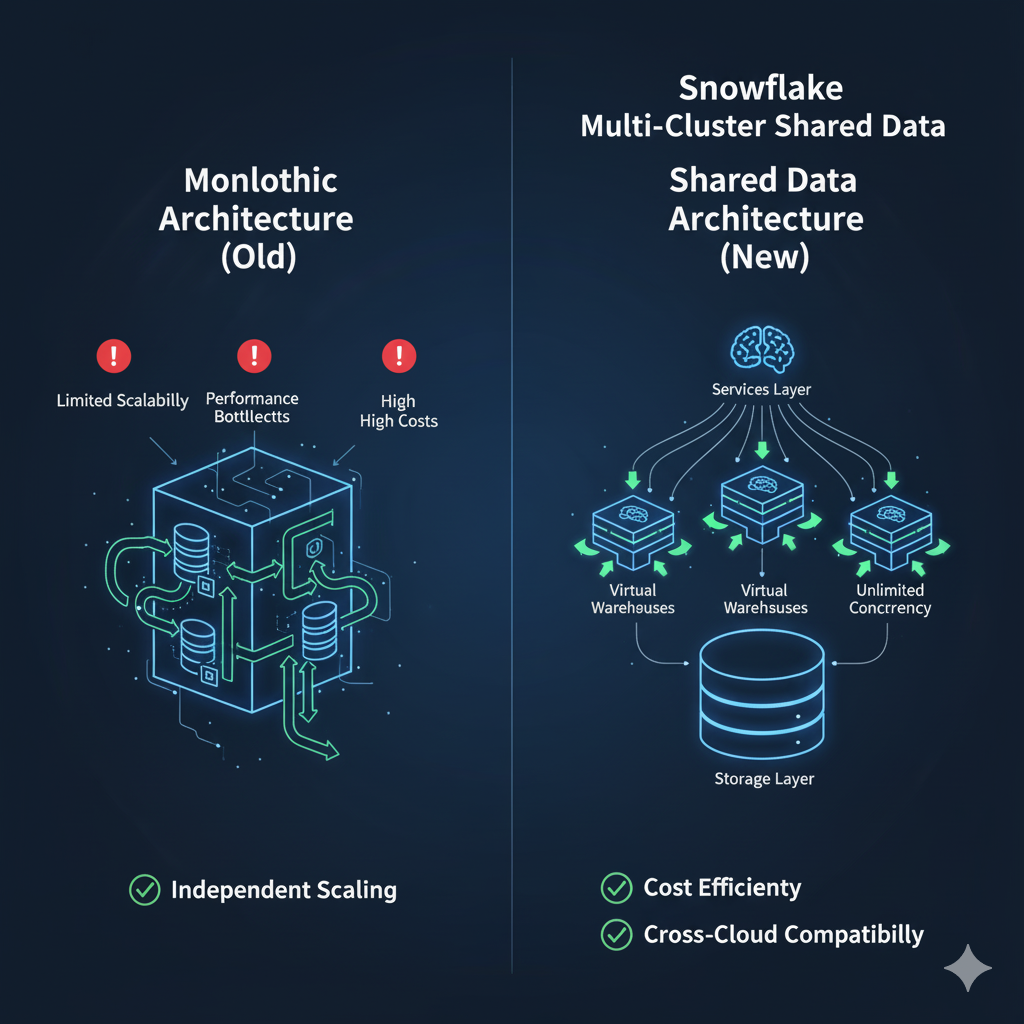
Before Snowflake, most data warehouses followed a monolithic architecture where storage and compute were tightly coupled. This created multiple challenges:
Snowflake solved these problems by introducing a multi-cluster, shared data architecture designed for the cloud.
Think of Snowflake as a high-speed train where the tracks (storage), engines (compute), and control center (services) operate independently but in perfect harmony.
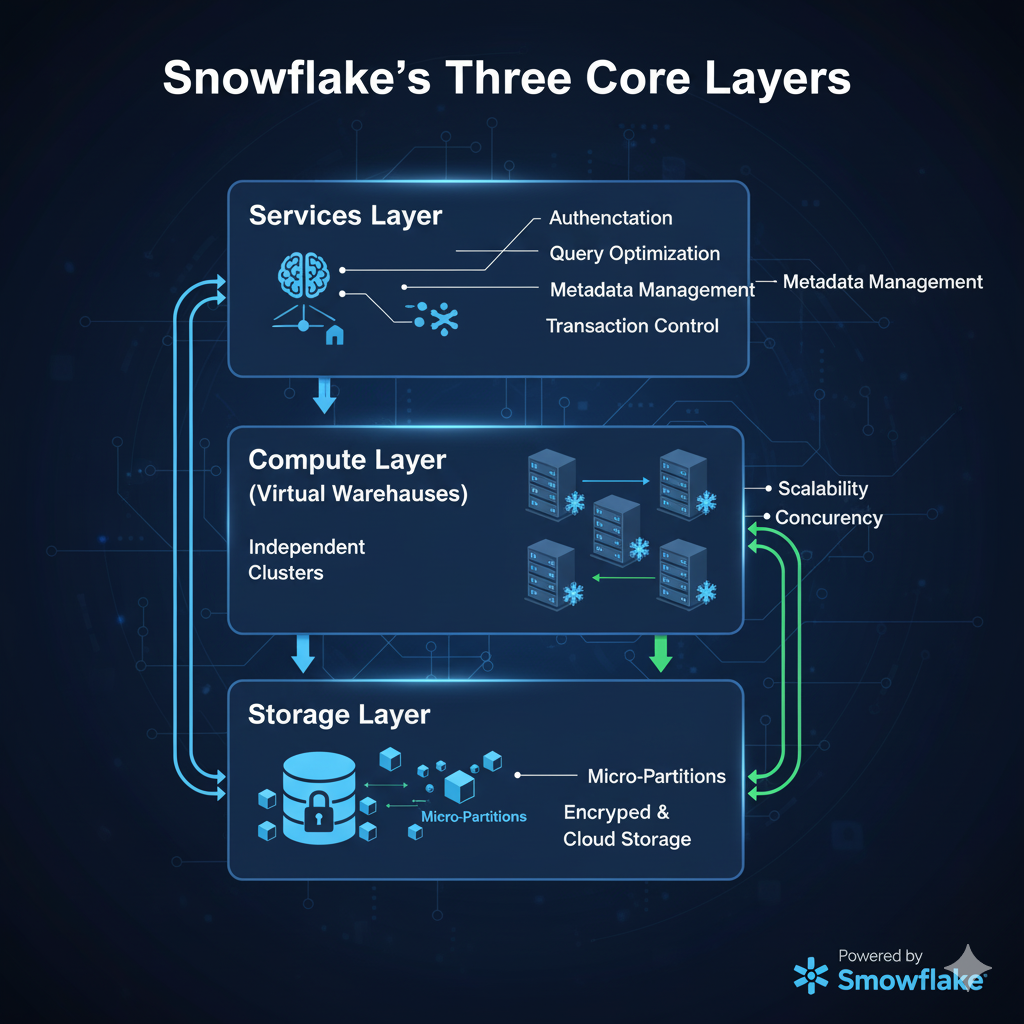
Snowflake is built on three core layers, each serving a specialized purpose but designed to work together efficiently.
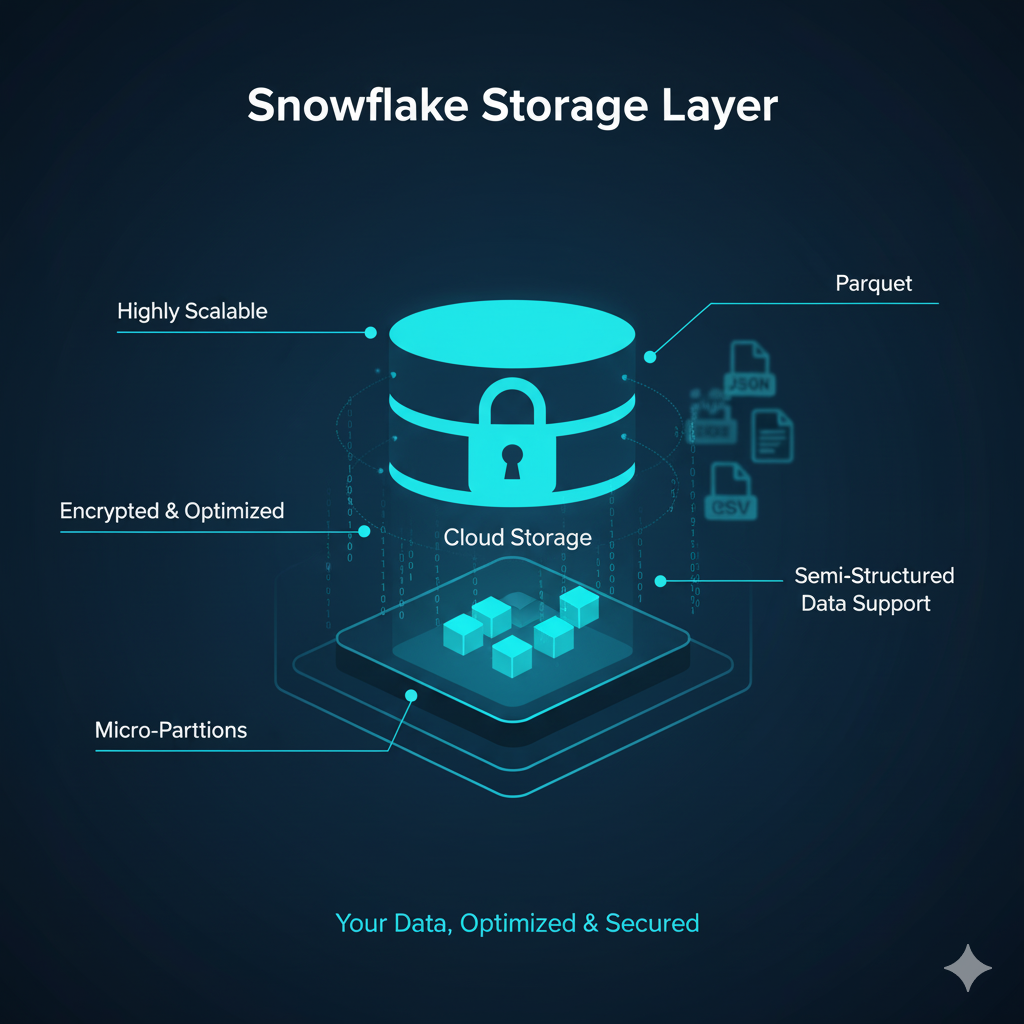
The storage layer is where all your structured and semi-structured data (like JSON, Parquet, and Avro) lives.
Snowflake automatically organizes data into compressed micro-partitions, making it faster to access and cheaper to store.
How it works:
Benefits of the storage layer:
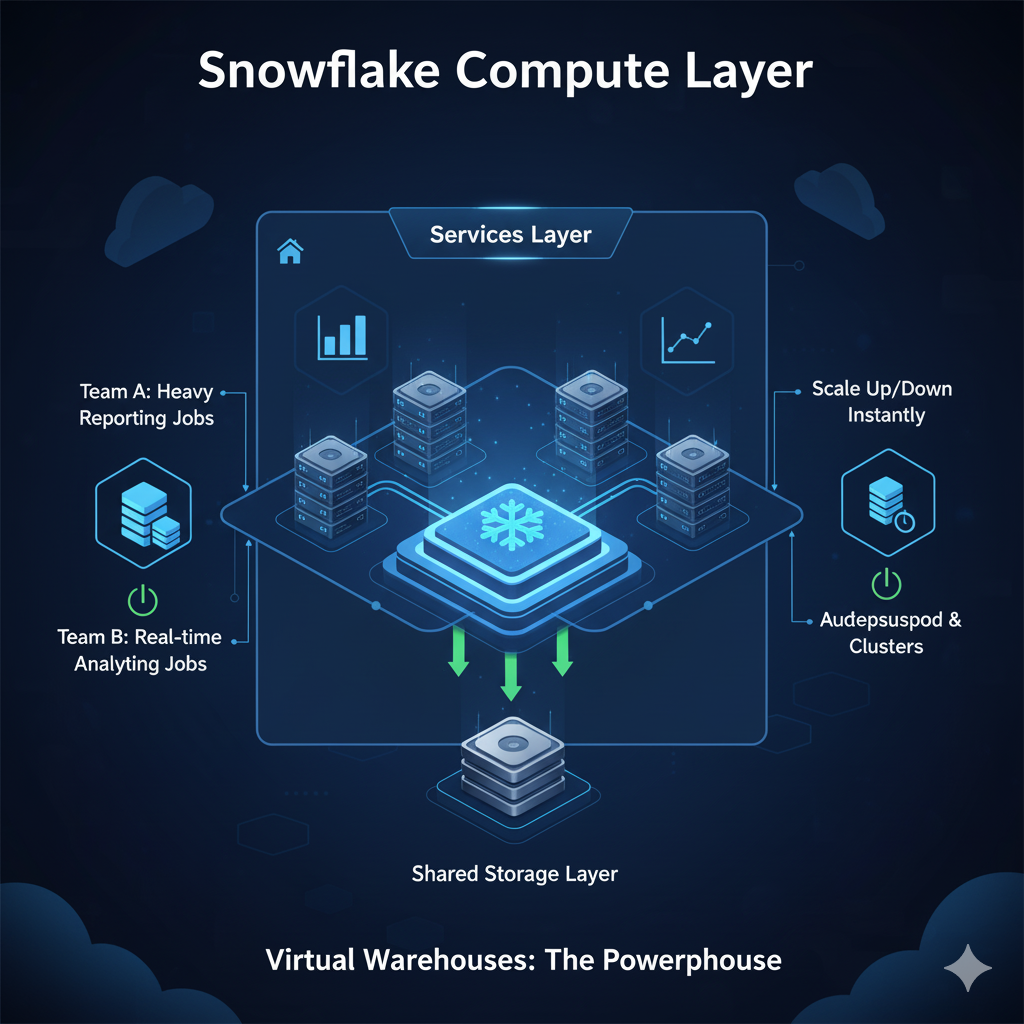
The compute layer is powered by Virtual Warehouses, which are independent clusters of compute resources used for running queries and processing data.
Key features of Virtual Warehouses:
Example Use Case:
Imagine a retail company:

The services layer is like Snowflake’s brain, coordinating and optimizing everything happening across storage and compute.
Core responsibilities include:
Think of the services layer as an air traffic controller — ensuring smooth and safe operations between all the moving parts.
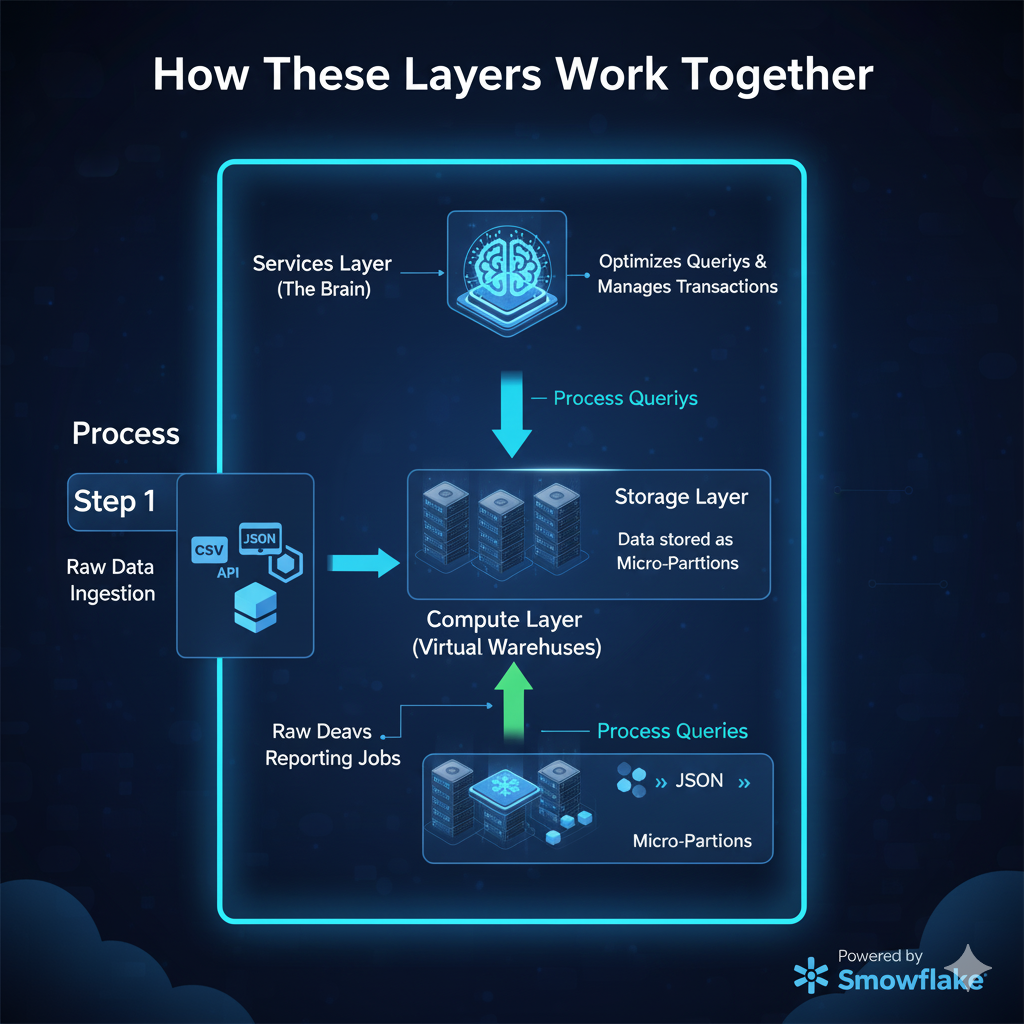
Here’s a step-by-step example of how data flows through Snowflake’s architecture:
| Step | Process | Snowflake Layer |
|---|---|---|
| 1 | Raw data is ingested from external sources (e.g., CSV, JSON, APIs). | Storage |
| 2 | Data is securely stored in micro-partitions. | Storage |
| 3 | A Virtual Warehouse spins up to process queries. | Compute |
| 4 | Services layer optimizes queries and manages transactions. | Services |
| 5 | Users get real-time analytics results. | Output |
This clear separation of responsibilities enables Snowflake to deliver unmatched speed, scalability, and reliability.
A global retail chain uses Snowflake to handle billions of daily transactions.
Result:
| Advantage | How Snowflake Delivers It |
|---|---|
| Scalability | Independently scale compute and storage as needed. |
| Performance | Query optimization and result caching. |
| Concurrency | Multiple teams query data simultaneously without conflicts. |
| Cost Optimization | Pay only for resources used, with auto-suspend features. |
| Cross-Cloud Flexibility | Works seamlessly on AWS, Azure, and GCP. |
Snowflake’s innovative architecture — with its separation of storage, compute, and services — has redefined what’s possible in modern data warehousing. By embracing this cloud-native model, businesses can achieve unlimited scalability, high performance, and cost efficiency like never before.
Whether you’re just starting your Snowflake journey or looking to optimize your existing setup, understanding the architecture is your first step toward data-driven success.
1. How does Snowflake separate storage and compute?
Snowflake uses independent layers for storage and compute. Data stays in the storage layer, while compute resources (Virtual Warehouses) process queries. This ensures performance and scalability without interference.
2. Is Snowflake a cloud data warehouse?
Yes, Snowflake is a fully managed cloud-native data warehouse that runs on AWS, Azure, and Google Cloud.
3. Can Snowflake handle both structured and semi-structured data?
Absolutely. Snowflake supports structured data like tables and semi-structured formats such as JSON, Avro, ORC, and Parquet.